Demolition Services in Shasta County, CA

Demolition services across Shasta County, CA, from clearing fire-damaged houses and burned lots to breaking out slabs and grading for a rebuild, written from the crew side of the fence.

What We Cover

Demolition Services in Shasta County, CA

Demolition in Shasta County, CA starts with the lot, not the machine. A house built in the 1950s in Redding has plaster over lath, old duct wrap and a cracked footing. A newer house out toward Palo Cedro has stud walls, drywall and a slab poured in one afternoon. The crew reads each one before the excavator is unloaded, because the structure decides the order of the work.

Fire-damaged lots across the county

A large share of the demolition around Shasta County follows wildfire, and the Carr Fire is still visible on hillsides west of Redding. Burned houses are cleared in a set order: utilities confirmed dead, hazards pulled out by hand, roof decking and framing taken down in sections, then the debris hauled in covered trucks. Ash is wetted the whole time, because summer wind in the Sacramento Valley carries dry ash a long way past the property line.

Slabs, footings and grade

Once the framing is gone, the concrete slab and footing are judged. Heat can crack and spall them, and some come out with a breaker or a jackhammer while others stay for the rebuild. After that, a skid steer and a small excavator shape the pad and drainage. Lots on the slopes near Whiskeytown Lake, Shasta Lake and along State Route 299 need erosion control in place before the winter rains.

Older homes and what is inside the walls

Houses built before 1980 are surveyed for asbestos and lead paint before any wall comes down. Abatement is done first by licensed crews, and demolition follows once clearance is in hand. Skipping that order spreads fibers over the yard and the neighbors, in Anderson and everywhere else along Interstate 5.

Guides

The pages here cover the order of work on a burned house, handling ash and debris, asbestos and lead surveys, fire-damaged slabs and footings, grading a burned lot for a rebuild, and what to check before choosing a crew. The articles add detail on trees, stumps and sorting debris across the county.

Latest Guides

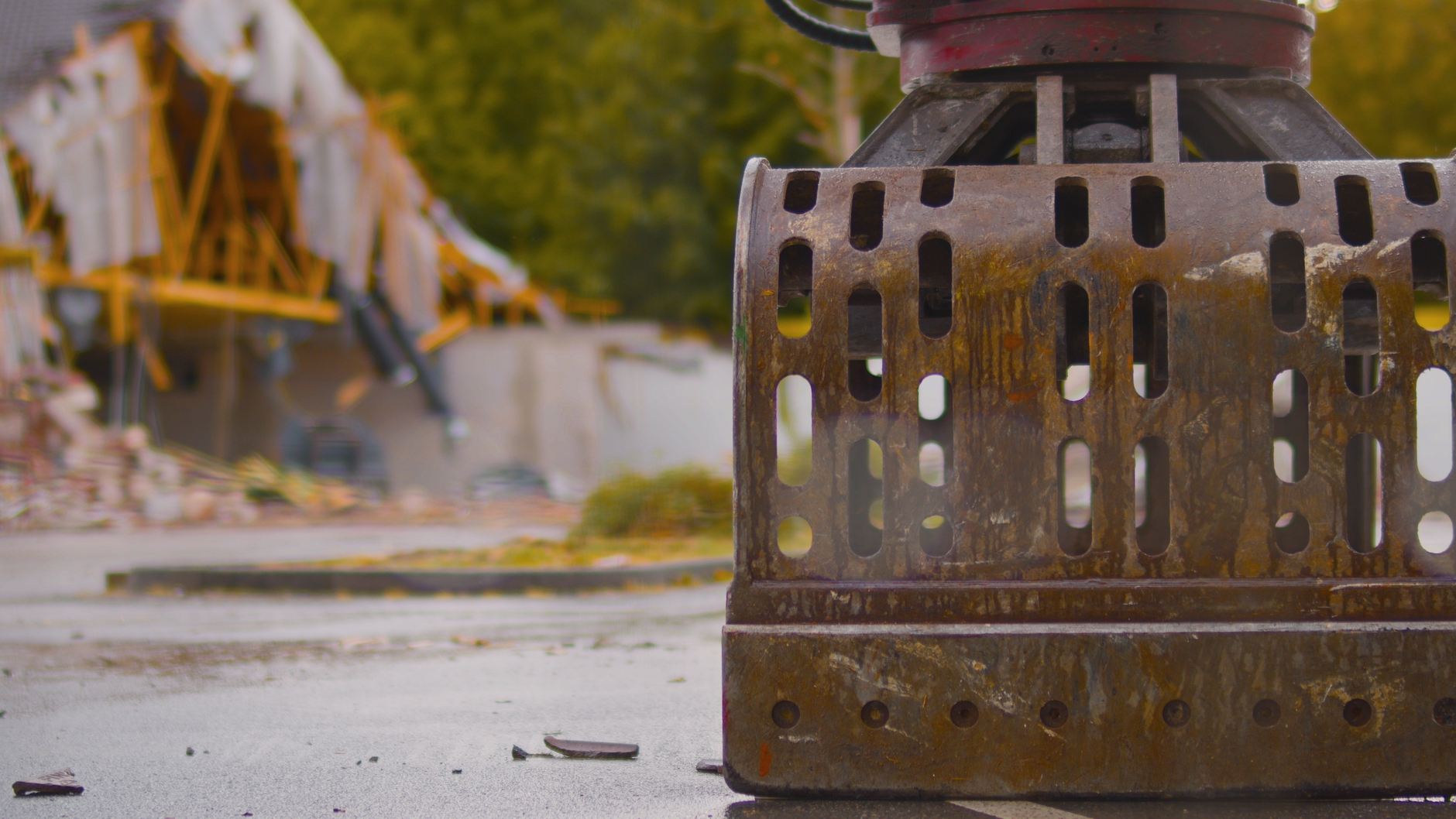
Close-up of a demolition grab on a construction site

Fire-Killed Trees and Stumps on a Burned Shasta County Lot: What Gets Removed and What Stays

2026-10-14

Fire-killed trees on a burned lot in Shasta County, CA come down before the house site is graded, because a dead oak or pine can drop limbs or fall whole onto the machines and onto any new framing. The trees are walked, marked and sorted into three groups: remove now, watch and leave, and cut but keep the stump. The sorting matters as much as the cutting, since a lot near Palo Cedro can hold forty trees and only a handful deserve a chainsaw on day one.

Which burned trees are dangerous enough to take down first

The dangerous ones are the trees that lean toward the house site, the driveway or a neighbor's fence, and any tree with a burned-out trunk base. A trunk charred through on one side can look solid from the road and still be held up by a thin strip of wood. Standing dead pine drops its top first. Oak tends to shed heavy limbs for a season or two after a fire, so the ground under it is treated as a work zone that nobody walks through.

Crews mark the trees with paint before any equipment moves in. A tree within one and a half tree-heights of the building pad is on the first list. Trees along State Route 299, Interstate 5 frontage roads or a shared road are also on that list, because a falling tree there reaches beyond the property line. Lots inside the Carr Fire burn area, west of Redding and toward Whiskeytown Lake, still carry many standing dead trunks.

How do you tell a dead tree from one that will recover

A scratch test on a small branch answers most of the question. Green under the bark means the cambium is alive. Brown or dry means it is not. Oaks in the Sacramento Valley foothills often resprout from the base after a fire, even when the crown looks dead, so a blackened oak with green sprouts at its foot is not removed on the first pass. Conifers do not resprout. A pine with all needles scorched brown and a charred lower trunk is almost always finished.

Arborists look at three things: how much of the trunk circumference is burned, how high the char climbs, and what the crown looks like a few weeks later. Waiting one growing season gives a clearer answer for borderline trees, but only if the tree stands far from anything it could hit.

What equipment does the work

Small trees come down with a chainsaw and a ground crew. Large burned trees need a different approach. A climber may not be able to trust the wood, so the work is done from a lift, or the tree is pushed over by an excavator with a thumb after the base is notched. Once on the ground, the trunk is cut into lengths that a skid steer with a grapple can load.

  • Chainsaw and ground crew for trees up to about a foot across
  • Bucket lift or crane for tall trees over the house pad
  • Excavator with a thumb for pushing, pulling and stacking
  • Skid steer with a grapple for loading cut lengths
  • Chipper for limbs that are clean enough to chip

Burned wood does not chip like green wood. The charred outside gums up the chipper knives, and the dust is black and fine. Most of it goes to the hauler as cut lengths instead.

What happens to the stumps and roots

Stumps inside the building footprint come out entirely, with the main roots, because a rotting root under a new slab leaves a void. An excavator digs around the stump, cuts the lateral roots with the bucket teeth, and lifts it out in one piece. The hole is backfilled in lifts and compacted, the same as any other fill on the pad.

Stumps outside the footprint are handled differently. On a steep slope near Whiskeytown Lake, pulling every stump can loosen the soil more than the fire already did. In that case the tree is cut low and the stump is left to hold the slope while new plants establish. Roots that have burned underground leave channels that carry water, so a spot with a collapsed stump hole gets probed and filled before winter.

Why burned roots matter for drainage

A burned root system leaves hollow tubes in the soil, and runoff finds them. Water that used to soak in across the slope can run down a root channel and come out as a small gully a few feet downhill. After rain on a burn scar, crews walk the lot looking for sinkholes and fresh cuts. Any soft ground within the building pad gets excavated to firm soil and rebuilt in layers.

How is the wood hauled and where does it go

Burned logs and chunks go to a facility that takes woody waste. Some mills accept burned logs with a clean cut face, and some biomass plants take chipped material. Heavily charred wood usually goes to a landfill or a green waste yard that accepts burn debris. The hauling company gives a ticket for each load, and the tickets are kept with the job file.

Trucks need a place to turn. On rural lots around Shasta County the driveway is often one lane, so the logs are stacked beside the road at a wide spot, where the truck can back in and the loader can reach.

  1. Cut the trunk into lengths that fit the truck bed.
  2. Stack the lengths within reach of the loader, off the road shoulder.
  3. Load the truck, tarp it and weigh it at the facility.
  4. Keep the weigh ticket with the project record.

Do any trees need a permit to remove

Some do. Oak trees above a certain size are protected under local rules in parts of California, and a tree on a slope or beside a creek can fall under separate protection. A fire-killed oak is often exempt after an arborist confirms it is dead, but the confirmation is needed in writing before the cutting begins. The Shasta County planning office answers that question, and the answer goes into the file next to the debris removal paperwork.

What about smaller brush and the burn layer on the ground

Fire leaves a layer of ash and charcoal across the ground, and under it a thin layer of soil that burned hot enough to repel water. That crust sheds rain instead of absorbing it. The top few inches are raked or scraped on the building pad and on the driveway route, and the material is hauled with the other debris. On the rest of the lot, the layer is usually left in place and covered with straw or mulch so it holds the slope.

Brush and small saplings are cut by hand or by a mower on a skid steer. Roots of small shrubs are left in the ground outside the pad, since they hold soil together.

How long does tree work take on a typical lot

A quarter-acre lot with a dozen burned trees usually takes two to four days for the cutting and one more day for hauling. A heavily wooded lot west of town toward Whiskeytown Lake can take two weeks. Weather matters: wind above twenty miles an hour stops work on tall dead trees, and wet ground can stop the heavy equipment from entering the slope.

Which order the lot work follows

Trees come down before the house debris is hauled if they threaten the house site, and after if they stand clear of it. Stumps come out before grading, so that the grading crew works on a single clean surface. The cleared lot is then walked once more for stray root pieces, nails and wire before the pad is compacted.

Dead trees are the last unpredictable part of a burned lot. Once they are down and the stumps are sorted, every later step, from the foundation to the framing, works on firm and level ground.
Read more →

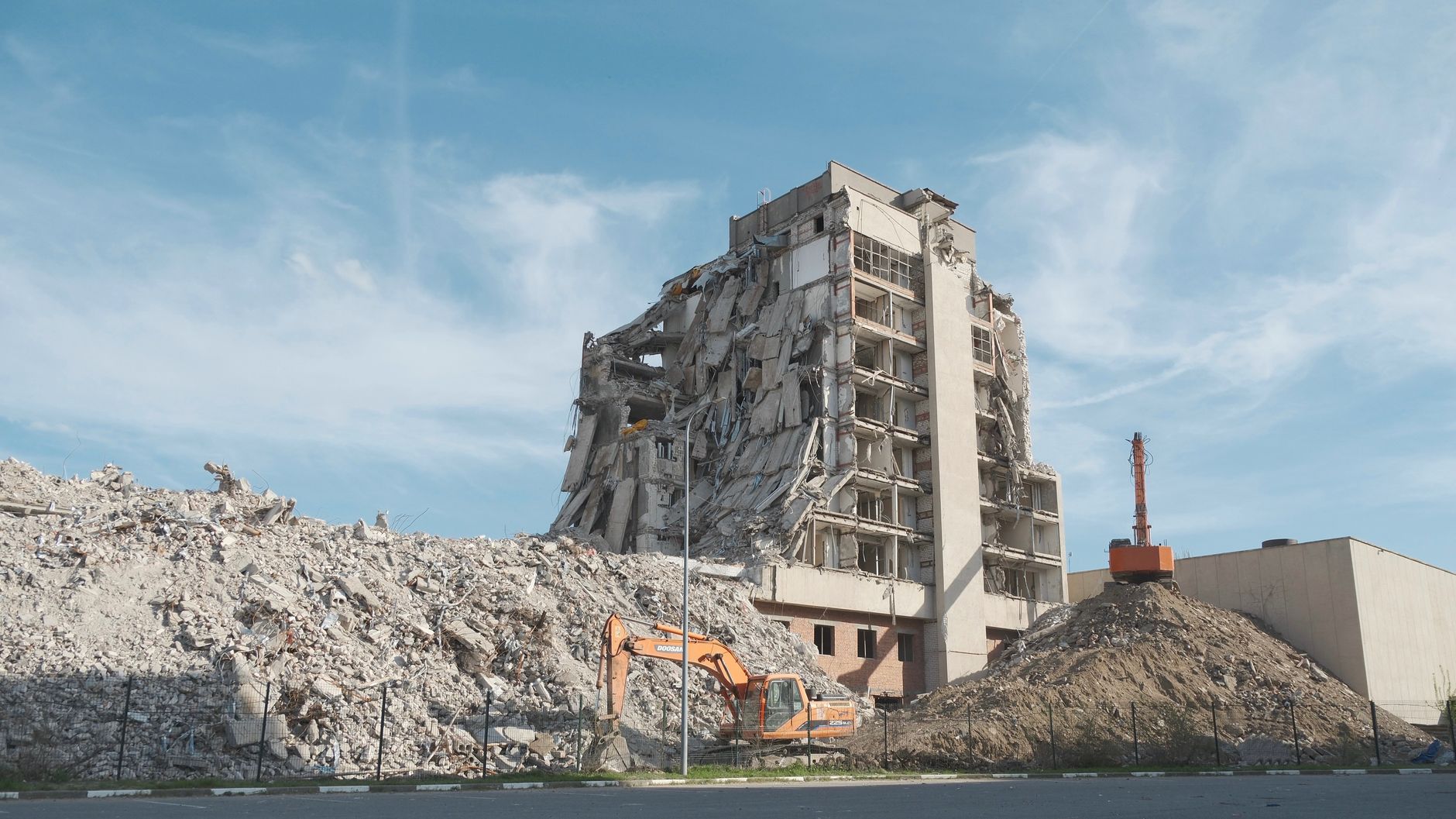
Urban demolition scene with a digger at a construction site

What Comes Out of a Burned House and Where It Goes After Demolition in Shasta County

2026-10-14

A burned house in Shasta County, CA leaves behind about a dozen different material streams, and each one goes to a different place. Metal and clean concrete are recycled, burned wood and ash go to a facility that takes fire debris, and anything with chemicals or asbestos goes to special handling. The sorting happens at the lot, as the machine pulls the house apart, because mixed loads are refused at most facilities or charged as the worst material in the truck.

Why is the debris sorted on site instead of at the dump

Sorting on site keeps loads clean and keeps the hauling count low. A truck full of only clean concrete can go to a crusher. A truck with concrete mixed into burned lumber goes to the landfill as a whole, since nobody picks it apart at the gate. A skid steer with a grapple and a few roll-off bins at the edge of the lot are enough to separate most of it as it comes down.

The main streams from a burned house

The table below lists what usually comes out and where each stream is headed. The destinations are the typical ones for Shasta County; a facility's own acceptance rules decide each load.

MaterialHow it is separatedUsual destination
Steel framing, roofing, rebarPulled by hand and by the grappleScrap metal yard
Copper wire and pipePicked from the pile by handScrap metal yard
Clean concrete slab and footingBroken with a breaker, rebar cut outConcrete recycler
Burned lumber and sheathingStacked with the excavatorWood waste or fire debris facility
Drywall, plaster and lathCollected in one binLandfill or drywall recycler
Ash and fine debrisWetted and scoopedFire debris facility
Glass, ceramic, tileSorted by the skid steerLandfill
Paint, fuel, batteries, pool chemicalsRemoved by hand firstHousehold hazardous waste
Asbestos-containing materialRemoved by licensed abatementApproved asbestos disposal

What can actually be recycled from a fire site

Metal is the best recovery from a burned house, and nearly all of it is accepted. Steel roofing, gutters, rebar, appliance shells and copper plumbing all go to the scrap yard, and heat damage does not change their value as scrap. Aluminum siding melts in a fire and fuses to other debris, so it may come out as a lump that still goes to metal recycling.

Concrete is next. A crusher takes concrete that is free of wood, dirt and trash, and turns it into road base. The slab from a burned house qualifies once the rebar is cut out and the surface is clear of ash and wood. Brick and block from a chimney or a garden wall are handled the same way.

Why is burned wood handled differently from clean lumber

Fire changes wood chemically on the surface and, in treated lumber, can release compounds that facilities do not want mixed into mulch or fuel. Burned wood from a house frame is generally treated as fire debris and goes to a facility set up for that stream. Pressure-treated posts, decks and fence boards are separated from the rest and handled on their own, since the preservative stays in the wood.

A few mills and biomass plants accept burned wood with a clean cut face. They often turn it down if it is soaked with ash or full of nails, so the load is shaken out and picked over before it is loaded.

How do fire debris facilities work with ash

Ash is wetted at the lot and loaded into covered trucks, then dumped at a facility with a designated area for it. The facility weighs the truck on the way in and on the way out. The difference is recorded on a ticket that shows the date, the truck and the material. Across Shasta County, where a large fire such as the Carr Fire can send many lots to the same facility in a few weeks, those tickets also help the county track what has been cleared.

What about household chemicals and appliances

Anything liquid or pressurized is taken out of the house before the machine starts. Paint cans, solvents, lawn chemicals, batteries, smoke detectors and propane bottles go into a separate container. Refrigerators and air conditioners contain refrigerant that must be recovered by a licensed technician before the unit is scrapped, so those are set aside and handled before the metal goes out.

Water heaters, furnaces and range hoods are mostly steel and go to scrap after the fluids are drained. Anything with a pilot light or gas valve is checked for leftover gas before it is cut.

What goes wrong with mixed loads

Mixed loads cause three problems. The first is rejection at the gate, which wastes the haul and forces a second trip. The second is a reclassification of the load to the most restricted material in it, so a truck of mostly clean concrete with a few asbestos tiles in it becomes an asbestos load. The third is a loss of recycling credit, because the facility only recycles what it receives clean.

  • Clean concrete with wood mixed in becomes landfill
  • Scrap metal with ash on it still sells, but a lot of wood stuck to it does not
  • Any suspect material in a load turns the whole load suspect

How tickets and records are kept

Every load leaves with a ticket and every ticket stays with the job. The file shows the date, the truck, the weight, the material and the facility. When the county reviews the lot for a rebuild permit, those tickets show where the material went. Homeowners with an insurance claim are often asked for the same records, so a complete folder saves time on both sides.

How the sorting changes with the age of the house

A house built in the 1950s in Redding or Anderson is likely to have plaster and lath, old floor tile and wrapped ductwork, which means more material goes to the restricted streams. A house built in the last twenty years has more drywall, vinyl and engineered lumber, and less material that needs special handling. The survey before demolition tells the crew which case applies, and the number of bins on the lot follows from it.

Who checks that the sorting was done right

The facility checks at the gate, the hauler checks at the lot, and the foreman checks as the machine works. At the gate, a scale operator or inspector looks into the truck bed and can send it back if the load does not match the ticket. At the lot, the foreman walks the bins at midday and again at the end of the day, looking for a stray tile, a can of paint or a piece of pipe wrap in a pile where it does not belong. A short walk-through of the bins each day catches most problems before the truck is loaded.

Photos of each full bin before it leaves are a simple extra record. If a load is questioned later, the photo shows what was inside when the truck pulled out, and the ticket shows where it ended up.

What is left when everything is sorted

What remains is a bare slab or a graded pad, a set of tickets, and a lot that is ready for the engineer. The sorting costs a little time on the first day and saves it every day after, because each truck leaves full and accepted the first time it arrives.

Read more →